Business Loan Finance Online Plant & Equipment Lease Calculator
Explore potential equipment leasing scenarios with our Plant & Equipment Lease Calculator. Test different lease amounts, residual (balloon) payments and repayment terms to estimate costs and see how varying finance assumptions may influence your business repayments and cash flow.
Calculator results are estimates based on the inputs and assumptions used and are provided for general information only. They are not quotes, offers, approvals, eligibility decisions or personalised recommendations, and do not indicate that a lender will provide credit. Actual rates, fees and repayments may differ.
Business Asset Lease Details:
Important!
Business Asset Lease Interest Rates differ from lender to lender and will depend on your individual circumstances (credit history, employment status, age, etc.).
Business Asset Lease Amortisation Calculator
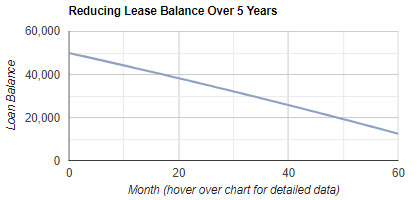
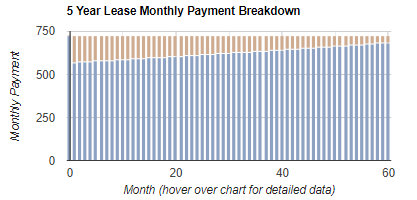
The following amortisation graphs detail month-by-month data on the progress of the proposed loan. The first chart below examines the reducing loan balance over the course of the finance contract term. The second graph illustrates the portion of each monthly repayment allocated to payment of interest vs principal reduction.
How to use our Plant & Equipment Lease Calculator
Our Plant & Equipment Lease Calculator helps business owners estimate lease repayments before you speak with a lender. It’s important because changing the residual (balloon), term and interest rate can materially affect cash flow, total interest paid and the end-of-term payout amount. The calculator provides estimates only and is general information, not personal advice; consider your objectives, financial situation and needs, and check the lease contract, fees and tax treatment with your accountant or adviser.
How to complete the calculator (best-practice order):
1. Purchase Price: Enter the total amount you want to finance, using whole numbers only (no dots or commas). Include relevant on-road and acquisition costs you intend to finance, such as applicable tax, stamp duty, registration, insurance or other costs.
2. Balloon or Residual Value: Choose the residual as a percentage of the purchase price. A higher residual usually lowers the ongoing repayments, but increases the amount due at the end and can increase the overall cost across the term. Select a residual that matches your expected end-of-term plan (refinance, trade-in, or pay out).
3. Term of Loan: Select the number of years. Longer terms typically reduce repayments but can increase total interest paid. Use a term that aligns with the asset’s useful life and how long you expect to keep it.
4. Interest Rate: Select a rate to simulate. The displayed range is indicative only; your actual rate depends on the lender and your circumstances and can only be confirmed after you apply.
5. Calculate: Run the estimate, then re-run scenarios to compare different residuals, terms and rates for a clearer view of affordability versus total cost.
How to interpret the results:
1. Repayment estimate: Treat this as a guide for budgeting, not a quote.
2. Residual due: Note the end-of-term balloon amount you’ll need to pay or refinance.
3. Amortisation graphs: Review how the balance reduces over time and how each repayment splits between interest and principal, which helps you understand cost versus payoff progress.
Working capital finance and business lines of credit can help Australian businesses manage short-term cash flow needs, seasonal expenses and timing gaps between income and outgoings. This guide explains how these facilities work, how they differ from standard business loans, and what to consider before applying. - read more
Secured and unsecured business loans differ mainly in whether the borrower offers assets as security. This guide explains collateral, personal guarantees, lender risk assessment and key questions Australian business owners should consider before applying. - read more
Before applying for business finance, Australian businesses can save time by checking common eligibility factors and preparing the documents lenders usually request. This checklist explains what lenders may review, what paperwork to gather and how to present your application clearly. - read more
Fresh October 2026 credit-demand data from Equifax, reported on 18 November 2026, suggests Australian households are becoming more cautious about large long-term borrowing while still leaning on shorter-term credit to manage everyday pressure. Mortgage demand fell sharply over the year, while credit card and personal loan demand moved higher, a split that says a lot about affordability, confidence and cash flow. - read more
The Reserve Bank of Australia’s latest board minutes have added important context to the 3 November increase in the cash rate, showing a central bank divided not over whether inflation matters, but over how much more pressure the economy can absorb. The board ultimately lifted the cash rate target by 25 basis points to 4.85%, with six members voting for the move and three preferring to hold at 4.60%. - read more
Fresh Australian Bureau of Statistics lending figures have highlighted a sharp reset in the housing finance market, with investor borrowing falling much faster than owner-occupier lending in the September quarter of 2026. For first home buyers, that may sound like a welcome shift after years of competing with cashed-up investors, but the same data also shows that getting into the market is still far from straightforward. - read more
Australia’s tight rental market is becoming a bigger driver of first-home buying intentions, with new research suggesting more renters are weighing up a purchase sooner rather than waiting for clearer property or rate conditions. For first-home buyers, the message is not simply to rush. It is to understand whether the desire to escape rent lines up with deposit savings, loan serviceability and the ongoing cost of ownership. - read more
Mortgagor: A person who offers to assign an asset as security (e.g. real estate) under a mortgage loan contract. The lender (mortgagee) holds the legal ownership of the security until the loan is repaid and the mortgage is discharged.