Business Loan Finance Online Bike Loan Repayment Calculator
Calculate motorcycle loan repayments in seconds with our Bike Loan Calculator. Compare finance options and plan your ride with confidence.
Calculator results are estimates only and not quotes. Actual quotes will be provided by licensed brokers after you submit an enquiry.
Bike Loan Details:
Important!
Bike Loan Interest Rates differ from lender to lender and will depend on your individual circumstances (credit history, employment status, age, etc.). To find out if you qualify ... and for a free, personalised interest rate and repayment quote,
please CLICK HERE
Bike Loan Amortisation Calculator
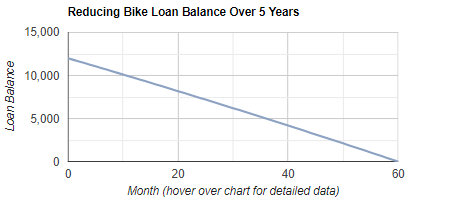
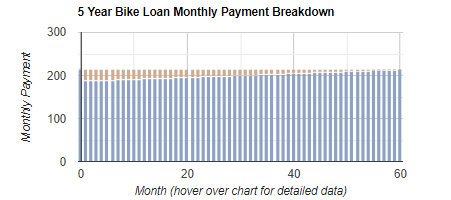
The following amortisation graphs detail month-by-month data on the progress of the proposed loan. The first chart below examines the reducing loan balance over the course of the finance contract term. The second graph illustrates the portion of each monthly repayment allocated to payment of interest vs principal reduction.
How to use our Bike Loan Repayment Calculator
Our Bike Loan Repayment Calculator is designed to estimate your motorcycle loan repayments in seconds, so you can compare bike finance options and plan your budget before you commit. It is important because small changes to loan size, term length and interest rate can materially change your monthly repayment and the total interest you pay over the life of the loan.
This calculator provides estimates only and is not personal financial advice. Results do not take into account your objectives, financial situation or needs. Interest rates and fees vary by lender and your individual circumstances, and your final rate can only be confirmed after an application is assessed.
How to complete the form for the best result:
1. Purchase Price
Enter the bike purchase price as a whole number (no dots or commas). If you expect to borrow extra for on-road costs such as stamp duty, registration or insurance, include those amounts in the figure you enter so the estimate better reflects your likely loan amount.
2. Deposit or Trade-in Value (if applicable)
Enter your deposit or trade-in value as a whole number. If you have no deposit, enter 0. A higher deposit generally reduces the amount borrowed and can reduce interest paid over time.
3. Term of Loan (Years)
Select a term between 1 and 7 years. Longer terms typically reduce monthly repayments but can increase the overall cost of the loan due to more interest over time. Choose a term that fits your cash flow, not just the lowest repayment.
4. Interest Rate (% per annum)
Select an interest rate for the simulation. If you are unsure, test a conservative higher rate to see whether repayments remain affordable.
5. Calculate
Click calculate to generate your estimated repayment and amortisation visuals.
How to interpret the results:
1. Repayment estimate
Use the repayment figure as a starting point for budgeting, then stress-test by increasing the rate or reducing your deposit to see how sensitive repayments are.
2. Amortisation graphs
Review the loan balance chart to understand how quickly you reduce what you owe, and the interest versus principal chart to see how much of each repayment goes to interest compared with reducing the loan balance over time.
Welcome to the world of loan interest rates, where understanding the nuances can have a significant impact on your financial journey. As a business owner, navigating through fixed and variable interest rates requires a solid grasp of their differences and how they affect your loans. - read more
Applying for a loan can be a crucial step in achieving your financial goals, whether you are buying a home, starting a business, or managing personal finance. However, navigating the loan application process can be tricky, with several potential pitfalls that can lead to frustration or application denial. - read more
Whether you're a budding entrepreneur or an established business owner, understanding your funding options is crucial in turning your innovative ideas into reality. The path to securing the right financial support can be both thrilling and challenging, making informed decisions a critical part of your success story. - read more
Creating a compelling pitch is crucial for any entrepreneur seeking to attract investors. It's more than just presenting numbers and forecasts; it's about connecting on a human level and conveying your vision effectively. - read more
Bank of Queensland’s latest market update points to a lending environment where banks are still prepared to write new business, but are being far more selective about risk, pricing and customer quality. For Australian borrowers, the practical takeaway is not that finance has disappeared. It is that applications now need to be cleaner, better evidenced and matched to the right product from the start. - read more
Australia’s rate outlook is again shaping the conversation for transport operators, with recent finance market attention turning to inflation, lender competition and the timing of any future borrowing cost relief. For truck buyers, the message is cautiously positive but not simple: lower rate expectations can improve confidence, yet lenders are still focused on serviceability, cash flow and the commercial case behind each vehicle purchase. - read more
A fresh release of Home Guarantee Scheme places has put low-deposit buying back in focus for Australians trying to move from renting or living at home into their first property. For buyers who have been saving steadily but feel the deposit target keeps shifting further away, the scheme can make a meaningful difference. - read more
Recent rural machinery coverage has again put precision spraying in the spotlight, with growers showing stronger interest in optical and camera-guided systems that can target weeds more selectively. For broadacre farms facing herbicide resistance, tighter chemical rules and rising input costs, the appeal is clear: better application accuracy, reduced waste and the potential to cover large areas with fewer unnecessary passes. - read more
Mortgage: A loan in which the borrower (the mortgagor) offers a property and land as security to the lender (the mortgagee) until the loan is repaid. Repayments of the loan are usually made on a monthly basis over a long period of time, typically 25 years.